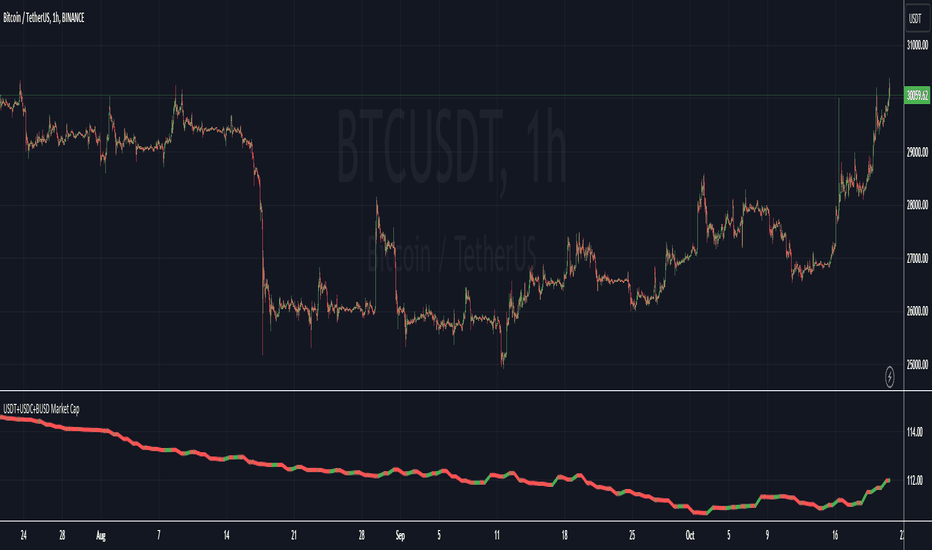
BTC Potential EnergyBTC Potential Energy is a macro-cycle oscillator that tracks how much "dry powder" is sitting in Tether (USDT) relative to its structural baseline — and translates that into a 0–100 potential energy score for Bitcoin. The core idea is simple: when investors are parking abnormal amounts of capital in stablecoins, that capital isn't gone — it's coiled. The higher the stablecoin accumulation above its own historical trend, the greater the potential for a violent rotation back into Bitcoin when sentiment shifts.
The indicator displays as a sub-pane oscillator beneath your BTC chart and is designed primarily for use on the Weekly or Daily timeframe , where macro cycle analysis is most meaningful.
The Concept: Stablecoins as a Coiled Spring
In crypto markets, Tether Dominance (USDT.D) is the percentage of total crypto market cap held in USDT. It rises when investors flee risk — selling Bitcoin and altcoins into stablecoins — and falls when investors deploy that capital back into the market.
This creates a physics-like analogy:
Compression phase — USDT.D rises as capital moves to safety. Like compressing a spring, potential energy builds.
Release phase — USDT.D begins to fall. The spring releases. Capital rotates into BTC, historically preceding or coinciding with the early stages of bull runs.
The further above normal USDT.D is, and the more abruptly it starts declining, the more powerful that rotation tends to be.
The Problem With Naive USDT.D Analysis
The most obvious approach — ranking the raw USDT.D value over history — fails in practice. Why? Because the stablecoin market has grown enormously since 2017. USDT.D in 2021 was structurally higher in absolute percentage terms than in 2018, simply because more stablecoins exist and are used as a base layer across DeFi and centralised exchanges. This secular uptrend means that if you rank raw USDT.D, the indicator reads "high energy" throughout the 2021 bull market — precisely when energy was already deployed and Bitcoin was already running. That is the opposite of useful.
The Solution: Detrended Potential Energy
BTC Potential Energy solves this by ranking the deviation of USDT.D from its own long-term moving average , not the raw level itself. This strips out the structural growth of the stablecoin market and isolates only the anomalous accumulation — the excess fear-driven or cycle-driven flight to safety that goes beyond what the baseline trend would predict.
Step 1 — Establish the Baseline
A long Simple Moving Average (default: 100 bars) is computed on USDT.D. On the weekly chart, this represents approximately 2 years — roughly one full Bitcoin market cycle. This MA acts as the "expected" or structural level of stablecoin dominance for any given period. It rises gradually over time as the stablecoin ecosystem matures, automatically adjusting the baseline to the era.
Step 2 — Compute the Deviation
The deviation is calculated as:
Deviation = USDT.D − Baseline MA
A positive deviation means USDT.D is elevated above its own trend — investors are accumulating stablecoins beyond what the baseline predicts. This is abnormal stablecoin hoarding, and it represents genuine potential energy.
A negative deviation means USDT.D is below trend — capital has already been deployed into risk assets. Energy has been discharged.
Step 3 — Percentile Rank the Deviation
The current deviation is ranked as a percentile against all deviation values in a rolling lookback window (default: 200 bars). This produces the final Potential Energy score on a 0–100 scale:
100 = The current stablecoin accumulation anomaly is the most extreme it has been in the entire lookback window. Maximum coiled energy.
50 = Deviation is average. Neutral state.
0 = USDT.D is at its most suppressed relative to trend. Capital is fully deployed. Energy is discharged.
This approach is robust across all market eras and does not require re-calibration as the stablecoin ecosystem grows.
The Four Energy States
The indicator identifies one of four states on every bar, displayed in the live info table and used to determine histogram colour.
ACCUMULATING (Blue)
PE is below 40. USDT.D is near or below its structural baseline. Capital is deployed or neutral. The market is in an active risk-on phase or the bear market has not yet produced meaningful stablecoin accumulation. No elevated potential energy.
BUILDING (Amber)
PE is between 40 and the Charge Threshold, and is rising. Stablecoin accumulation is growing above the baseline. Investors are beginning to retreat from risk. Potential energy is loading. Worth monitoring but not yet at an actionable level.
CHARGED (Orange/Red)
PE is above the Charge Threshold (default: 65). USDT.D is historically elevated relative to its own trend. A significant amount of capital is sitting in stablecoins beyond what the baseline predicts. The spring is fully coiled. Bitcoin's potential energy is at its most loaded.
RELEASING (Green)
PE is above the Charge Threshold AND USDT.D deviation has been declining for N consecutive bars (default: 3). This is the critical state — energy that was compressed is now actively unwinding. Capital is rotating out of stablecoins. Historically, this condition — high stablecoin accumulation followed by a structural reversal — has preceded or coincided with meaningful Bitcoin bull moves.
Release Signal Logic
The release signal is intentionally conservative. Two conditions must be met simultaneously:
1. Armed: The Potential Energy score must be at or above the Charge Threshold. The spring must actually be compressed before a "release" means anything. A declining USDT.D from a low base is not a release — it's just noise.
2. Declining: USDT.D deviation must have been falling for at least N consecutive bars (configurable). This filters out single-bar blips and requires a structural turn, not just a one-week dip.
When both conditions are met, the histogram turns green for the duration of the release phase, and an alert can be triggered on the first bar the signal fires.
Visual Guide
Histogram colour
Deep Blue → Sky Blue: Low energy (PE 0–50), capital deployed
Gold: Moderate energy (PE 50–threshold), building phase
Amber/Orange: High energy (PE above threshold), fully charged
Green: Release phase active — deviation unwinding from a high base
Background glow: Subtly tints the pane background to reflect the current energy state — deep blue at low energy, warming to amber and orange as energy builds.
Dashed orange line: The Charge Threshold. PE crossing above this line arms the release detector.
Dotted grey line: The 50 midpoint. PE above 50 means the deviation is in the upper half of its historical range.
Fast MA (blue) / Slow MA (pink): Moving averages of the USDT.D deviation, projected into the 0–100 PE space. When fast crosses above slow, deviation is accelerating upward — energy building faster. When fast crosses below slow from above the threshold, it can precede a release signal.
Info Table (top right):
Energy Level — Current PE score out of 100
USDT.D — Raw live Tether Dominance reading
Baseline — The long MA value, the structural floor
Deviation — How many percentage points USDT.D is above or below baseline (+ is elevated, − is deployed)
State — Current energy state in plain text
Trend MA — The baseline length setting in use
Settings Reference
Percentile Lookback (default: 200)
The rolling window used to rank the current deviation. Longer lookbacks give more historical context but are slower to respond to structural shifts. 200 bars on the weekly is approximately 4 years — long enough to capture a full bull/bear cycle.
Trend Baseline MA (default: 100)
The most important parameter. This defines the structural floor. On the weekly chart, 100 bars is roughly 2 years — approximately one Bitcoin market cycle. Shorter values (e.g. 52 bars = 1 year) make the baseline more responsive, which can be useful on the daily chart. Longer values (130–150 bars) create a smoother, slower-moving baseline that irons out mid-cycle noise.
Signal Smoothing (default: 3)
EMA applied to raw USDT.D before any calculations. Reduces candle-to-candle noise in the source data. Higher values produce a cleaner but more lagged signal.
Charge Threshold (default: 65)
The PE level that must be reached before the release detector is armed. Raising this to 70–80 produces fewer, higher-conviction signals. Lowering it to 55–60 will trigger signals more frequently but with potentially lower reliability.
Consecutive Bars Declining (default: 3)
The number of consecutive bars that the deviation must be falling before a release is confirmed. Increasing this requires a more sustained reversal and reduces false positives. On the weekly chart, 3 bars is already meaningful — that is 3 weeks of sustained stablecoin outflows.
Fast MA / Slow MA Length (defaults: 14 / 50)
Moving averages of the deviation plotted in PE space. The crossover of fast above slow while PE is below threshold is worth watching as early warning of building energy. A crossover of fast below slow from above the threshold can precede a release signal.
Recommended Usage
Timeframe: Weekly or Daily. This is a macro cycle indicator. Do not use it to time intraday entries — it is not designed for that.
Combine with price structure: The release signal is most powerful when it aligns with Bitcoin reclaiming a key level, a breakout of a multi-month range, or a bullish divergence on a momentum indicator. The Potential Energy score tells you the setup is primed — price action confirmation tells you it is firing.
Watch the Deviation column: The live table shows the raw deviation in percentage points. A deviation of +1.5% means USDT.D is 1.5 percentage points above its 2-year average — that is a meaningful anomaly. Watching this number decline from a peak as the state transitions from CHARGED to RELEASING gives an intuitive real-time read of the rotation.
Baseline MA tuning: On the weekly chart, start with the default 100. On the daily chart, consider reducing the Trend Baseline MA to around 52 bars to keep the baseline responsive to faster-moving daily USDT.D data.
Alerts
Three alert conditions are available:
BTC PE — Energy Release: Fires on the first bar the release condition is met. The most actionable alert. USDT.D deviation is actively unwinding from an elevated zone.
BTC PE — Fully Charged: Fires when PE crosses above the Charge Threshold from below. Signals that potential energy has entered the high zone.
BTC PE — Energy Exiting High Zone: Fires when PE crosses below the Charge Threshold from above. Useful as a heads-up that the setup may be resolving.
Notes
This indicator uses request.security("CRYPTOCAP:USDT.D") to pull Tether Dominance data sourced from CoinMarketCap's crypto market cap feed via TradingView.
This indicator is a research and analysis tool. It does not constitute financial advice. Past correlations between Tether Dominance behaviour and Bitcoin price movements do not guarantee future results. Always combine macro oscillator readings with your own price analysis, risk management framework, and market context.
Indicador Pine Script®