Volatility Structure Regime Engine (VSgRE)Volatility Structure Regime Engine (VSgRE)
Volatility Structure Regime Engine (VSgRE) is a volatility-based market analysis tool designed to highlight when volatility is likely to expand, without implying trade direction.
The indicator uses a three-layer analytical framework to identify meaningful volatility events while remaining fully direction-agnostic.
🔹 Structure Layer
Defines the broader volatility environment using normalized volatility metrics to distinguish between high- and low-volatility conditions.
🔹 Regime Layer
Identifies volatility compression, expansion, and transition phases, helping traders recognize periods of stored or released market energy.
🔹 Execution Layer
Detects real-time volatility ignition events that signal the start of meaningful expansion.
📊 Signal Types
Strong Signals
Indicate valid volatility expansion events within an active volatility regime.
Elite Signals
Highlight the first volatility expansion following a prolonged compression phase.
Signals are represented using neutral bubbles to avoid bullish or bearish bias.
✅ Key Characteristics
Pure volatility-based logic
Leading, non-directional signals
Clean and minimal chart visuals
State-based, non-repetitive signaling
Suitable for breakout timing, regime analysis, and risk awareness
⚠️ Disclaimer
This indicator is provided for educational and analytical purposes only. It does not constitute financial advice. Trading involves risk, and users are responsible for their own decisions.
Market-regime

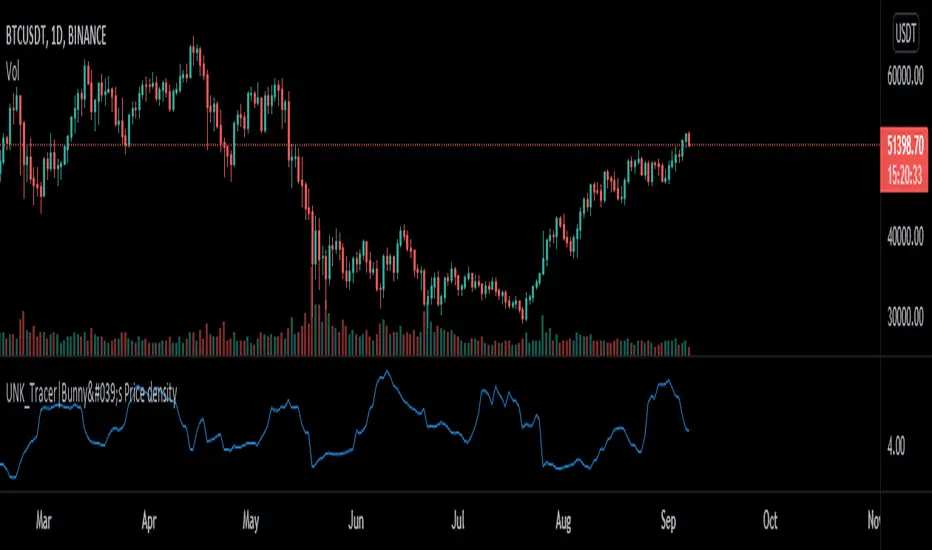
Price density [Measuring Market Noise:Take advantage]$$ Market noise can be problematic to some types of trading strategies yet beneficial to others.
By measuring noise using the 'Price Density' can enable us to improve our
trading edge and turn noise to our advantage.
Robust analysis of noise can inform us when it is best to avoid trend-following
systems (when noise is too high), and vice versa for systems based on a
mean-reverting trading premise (when market noise is low).
__________________________________________________________________________
Using Noise to our advantage
* Two techniques:
-Measure Noise and trade when suitable for the system
~ High noise = avoid trend-following
~ Low noise = avoid mean-reversion
-Match assets to strategies
~ Only trade 'noisy assets' with Mean-reversion Strategies
~ Only trade 'efficient assests' with Trend-following Strategies
## Price density:-
High values = High noise
Low values = Low noise
___________________________________________________________________________
Disclaimer!! Do your own research