FunctionElementsInArray
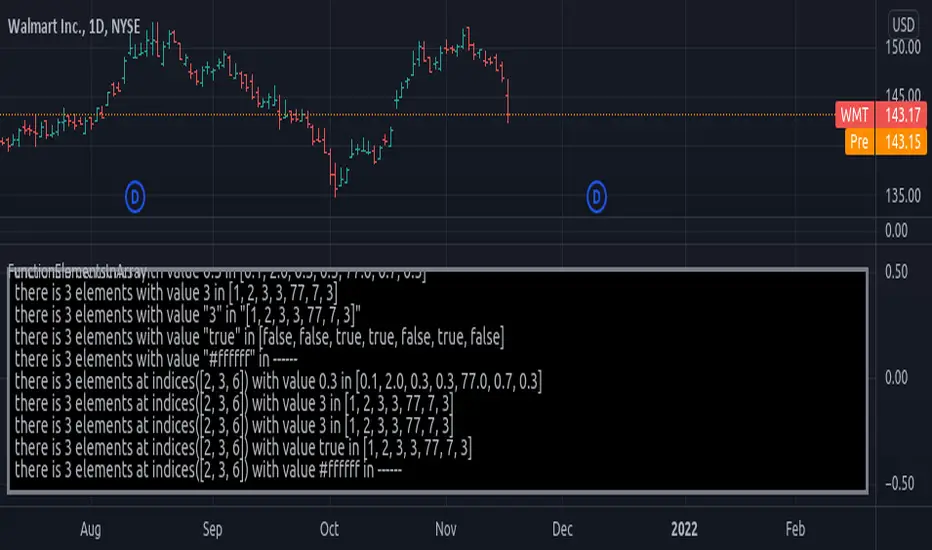
Methods to count number of elements in arrays
count_float(sample, value) Counts the number of elements equal to provided value in array.
Parameters:
sample: float array, sample data to process.
value: float value to check for equality.
Returns: int.
count_int(sample, value) Counts the number of elements equal to provided value in array.
Parameters:
sample: int array, sample data to process.
value: int value to check for equality.
Returns: int.
count_string(sample, value) Counts the number of elements equal to provided value in array.
Parameters:
sample: string array, sample data to process.
value: string value to check for equality.
Returns: int.
count_bool(sample, value) Counts the number of elements equal to provided value in array.
Parameters:
sample: bool array, sample data to process.
value: bool value to check for equality.
Returns: int.
count_color(sample, value) Counts the number of elements equal to provided value in array.
Parameters:
sample: color array, sample data to process.
value: color value to check for equality.
Returns: int.
extract_indices_float(sample, value) Counts the number of elements equal to provided value in array, and returns its indices.
Parameters:
sample: float array, sample data to process.
value: float value to check for equality.
Returns: int.
extract_indices_int(sample, value) Counts the number of elements equal to provided value in array, and returns its indices.
Parameters:
sample: int array, sample data to process.
value: int value to check for equality.
Returns: int.
extract_indices_string(sample, value) Counts the number of elements equal to provided value in array, and returns its indices.
Parameters:
sample: string array, sample data to process.
value: string value to check for equality.
Returns: int.
extract_indices_bool(sample, value) Counts the number of elements equal to provided value in array, and returns its indices.
Parameters:
sample: bool array, sample data to process.
value: bool value to check for equality.
Returns: int.
extract_indices_color(sample, value) Counts the number of elements equal to provided value in array, and returns its indices.
Parameters:
sample: color array, sample data to process.
value: color value to check for equality.
Returns: int.
removed type references from name, as previously was not possible to use same name functions with different signature.
Added:
count(sample, value) Counts the number of elements equal to provided value in array.
Parameters:
sample: color array, sample data to process.
value: color value to check for equality.
Returns: int.
extract_indices(sample, value) Counts the number of elements equal to provided value in array, and returns its indices.
Parameters:
sample: color array, sample data to process.
value: color value to check for equality.
Returns: int.
Removed:
count_float(sample, value) Counts the number of elements equal to provided value in array.
count_int(sample, value) Counts the number of elements equal to provided value in array.
count_string(sample, value) Counts the number of elements equal to provided value in array.
count_bool(sample, value) Counts the number of elements equal to provided value in array.
count_color(sample, value) Counts the number of elements equal to provided value in array.
extract_indices_float(sample, value) Counts the number of elements equal to provided value in array, and returns its indices.
extract_indices_int(sample, value) Counts the number of elements equal to provided value in array, and returns its indices.
extract_indices_string(sample, value) Counts the number of elements equal to provided value in array, and returns its indices.
extract_indices_bool(sample, value) Counts the number of elements equal to provided value in array, and returns its indices.
extract_indices_color(sample, value) Counts the number of elements equal to provided value in array, and returns its indices.
Biblioteca Pine
Fiel al espíritu de TradingView, el autor ha publicado este código de Pine como biblioteca de código abierto, para que otros programadores Pine de nuestra comunidad puedan reutilizarlo. ¡Enhorabuena al autor! Puede usar esta biblioteca de forma privada o en otras publicaciones de código abierto, pero la reutilización de este código en publicaciones está sujeta a nuestras Normas internas.

Exención de responsabilidad
Biblioteca Pine
Fiel al espíritu de TradingView, el autor ha publicado este código de Pine como biblioteca de código abierto, para que otros programadores Pine de nuestra comunidad puedan reutilizarlo. ¡Enhorabuena al autor! Puede usar esta biblioteca de forma privada o en otras publicaciones de código abierto, pero la reutilización de este código en publicaciones está sujeta a nuestras Normas internas.