How the Venezuelan Crisis Is Reshaping Crypto and Gold MarketsOil, Real Rates, and Geopolitics in 2025: How the Venezuelan Crisis Is Reshaping Crypto and Gold Markets
By Teo Mariscal Díaz
December 2025
I have spent my career studying behavior. How humans and animals respond to stimuli, how they adapt, how they navigate complex environments. This experience has taught me something that applies far beyond standard psychology: all behavior is rational within its own context. Every action, even those that seem erratic or contradictory, follows patterns. Once you understand the incentives driving the behavior, the pattern becomes clear.
The financial markets are not so different from an animal responding to its environment. They react. They adapt. They follow incentives. And when you see multiple markets moving in apparently unrelated ways, what you are actually observing is a coordinated response to structural incentives that are not always visible on the surface.
This is why I enjoy theorizing about macro events. They are rarely what the headlines suggest. Behind every apparent crisis, every geopolitical escalation, every market movement, there is almost always a deeper causal structure that explains why things move together at precisely the moment they do.
Venezuela in 2025 is a perfect example of this principle. And it is reshaping the markets for crypto and gold in ways that most traders are not yet recognizing.
THE CORE PROBLEM: REAL RATES ARE TOO HIGH
The United States currently faces an unusual macroeconomic configuration. Nominal interest rates remain elevated at 4.25 to 4.50 percent while inflation has collapsed to 2.1 percent year-over-year. This produces real rates in the 2.0 to 2.5 percent range—substantially above historical norms and dangerously restrictive.
This matters because real rates influence everything: business investment, credit availability, asset valuations, and employment. When real rates are too high, the economy exhibits stress behavior. Unemployment rises. We saw this in 2024, with unemployment reaching 4.6 percent by December—the highest since 2019.
The Federal Reserve faces a trap. To ease real rates, the Fed would need to cut nominally. But cutting aggressively risks reigniting inflation. Doing nothing allows real rates to remain restrictively high, risking recession.
The solution requires not monetary policy but something else: a change in inflation expectations. If inflation could be pushed modestly higher without becoming unanchored, real rates would normalize downward without the Fed needing to cut.
This is where oil enters the analysis.
THE OIL PRICE MECHANISM
Oil is the largest driver of near-term inflation in the United States. When oil prices are too low—as they were in late 2024 at 65 to 70 dollars per barrel—they exert downward pressure on inflation through multiple channels:
Direct CPI effects: Lower gasoline and heating oil prices reduce the energy component of the Consumer Price Index.
Indirect effects: Lower transportation costs reduce wholesale prices, which feed into goods prices.
Expectation effects: Falling oil prices anchor inflation expectations downward.
Monetary policy effects: Lower inflation justifies lower real rates in the Fed's framework.
All four channels work in the same direction. Low oil leads to falling inflation, which leads to rising real rates, which leads to tighter financial conditions, which leads to weaker demand, which leads to further pressure on oil prices.
For the Trump Administration, which explicitly prioritizes strong asset markets, this dynamic is untenable. The administration requires a policy solution to push oil prices higher and stabilize inflation.
VENEZUELA: JUSTIFIED ACTION, MACRO-ECONOMIC MOTIVATION
Venezuela is a narco-state. This is documented fact, not speculation. I know this from my work training canine detection units and law enforcement personnel in these regions. The quantities of cocaine moving through the Zulia State bordering Colombia are staggering. The scale and sophistication of the trafficking operation are remarkable. This is not theoretical—it is what trained police, DEA personnel, and detection specialists on the ground have documented.
The Maduro regime has been implicated in direct involvement with drug trafficking organizations. The connection between the Venezuelan state apparatus and narco-trafficking is established in law enforcement documentation and judicial proceedings.
However, one can acknowledge that Venezuela is genuinely a narco-state while simultaneously recognizing that this reality may not be the primary driver of recent U.S. policy escalation.
The Trump Administration has deployed Venezuela's narco-state status as justification for blockades, asset seizures, expanded sanctions on PDVSA, and diplomatic isolation. These justifications are real—the underlying facts are true. But the intensity and timing of escalation warrant closer examination.
Here is the critical distinction: justified action versus motivated action.
Justified action occurs when a government uses a true fact as the basis for policy. Motivated action occurs when policy behavior is driven primarily by economic incentive rather than the stated justification. These are not mutually exclusive. A policy can be both justified (narco-state is real) and motivated by different primary causes (oil price stabilization).
The question is: Would the blockades, seizures, and escalation have occurred at the exact timing and intensity they did if oil prices were at 100 dollars per barrel instead of 65 dollars per barrel?
The honest answer is that we cannot know for certain. But the convergence of timing is instructive.
WHY TIMING MATTERS MORE THAN JUSTIFICATION
The narco-state justification has been true for years. Venezuela's involvement in drug trafficking is not new. The Zulia State has been a cocaine logistics hub for a decade or more. Law enforcement has documented this for years.
If counter-narcotics were the primary driver, why escalate precisely in late 2024 when oil prices had collapsed to 65 to 70 dollars per barrel and real rates had reached 2.15 percent?
One could argue that perhaps new intelligence emerged. This is possible. But it is less parsimonious than the alternative: Existing true facts (narco-state) were deployed in service of a new macro objective (stabilizing oil prices and real rates).
The timing is the key variable. The facts have not changed. What has changed is the macroeconomic necessity for those facts to be deployed.
THE ANALYTICAL FRAMEWORK
Multiple truths coexist simultaneously:
Venezuela is a narco-state. This is REAL.
Counter-narcotics concerns are LEGITIMATE.
The blockade is JUSTIFIED by these facts.
The primary motivation for escalation timing and intensity is MACRO-ECONOMIC: stabilizing oil prices and real interest rates.
This is not a conspiracy theory. It is coherent incentive analysis. The narco-state fact is not invented. The blockade is not unjustified. But the macro-economic incentive is the primary driver of timing and intensity.
This is how sophisticated policy actually works. Multiple objectives align, and real facts provide justification for policy that is primarily motivated by other concerns.
IMPACT ON CRYPTO AND GOLD MARKETS
Gold's Rally: Signaling Macro Distress
Gold has long served as the market's barometer of real-rate stress. Gold tends to rise when real rates are elevated and expected to remain elevated. Gold rises when policy credibility is questioned. Gold rises when geopolitical risk increases. Gold rises when inflation anchoring becomes uncertain.
Gold surged from approximately 2,000 dollars per ounce in mid-2024 to 2,700 dollars per ounce by December 2024—a 35 percent increase in six months. This rally occurred precisely when real rates were at 2.15 percent or higher, unemployment was rising, recession risk was increasing, and inflation expectations remained anchored below 2.5 percent.
Gold was signaling: This macro configuration is unsustainable. Something must give. Real rates are too high. Growth is at risk. Policy will be forced to adjust.
Cryptocurrency: The Risk Asset
Bitcoin differs from gold in a crucial way. It is not primarily a safe haven. It is a risk asset with macro sensitivity. Bitcoin rises in environments of adequate but not excessive inflation (2 to 3 percent range), declining real rates, expanding monetary conditions, and rising asset risk appetite.
In late 2024, as real rates reached 2.15 percent or higher and recession risk rose, Bitcoin struggled. It fell from approximately 69,000 dollars in November 2024 to 42,000 dollars by late December—a 39 percent correction in two months.
The Critical Insight: Geopolitical Risk That Stabilizes Rates Is Bullish for Crypto
Not all geopolitical risk is equally bearish for crypto. When geopolitical risk serves to stabilize real rates and inflation expectations, the dynamics shift. A geopolitical event that pushes oil higher, raises inflation toward the Fed's target, and eases real rates is bullish for crypto precisely because it removes the macro headwind suppressing the asset.
The Venezuelan sanctions exemplify this dynamic. The escalation reduces oil supply, pushes prices toward 80 to 85 dollars per barrel, lifts inflation expectations to 2.5 to 2.8 percent, and reduces real rates from 2.15 percent to 1.20 percent. This eases financial conditions and supports risk appetite.
All of these effects are supportive for crypto valuations.
The Divergence Paradox
Currently, markets are pricing in a contradictory scenario. Gold is rising, signaling high real rates and macro distress. Oil is falling, signaling weak demand and deflation. Crypto is volatile, uncertain about which macro regime is primary.
This divergence cannot persist indefinitely. It reflects deep market confusion about the macro regime.
The Venezuelan situation is the resolution mechanism for this divergence. If sanctions succeed in pushing oil higher, the gold bull case is invalidated and the crypto bull case is activated. If sanctions fail and oil continues lower, the gold bull case is confirmed.
For traders, monitoring oil prices relative to gold prices is the most reliable indicator of which macro regime is winning.
THE FEDERAL RESERVE'S DILEMMA
The Federal Reserve faces an extraordinarily difficult policy choice in 2025, constrained from multiple sides.
The Cutting Trap: If the Fed cuts rates aggressively, inflation risks re-accelerating. Fiscal stimulus remains elevated. Energy markets are tight. Supply chains retain fragilities. Labor markets remain relatively tight. An aggressive rate-cutting cycle could easily re-ignite inflation back to 3 to 4 percent.
The Holding Trap: Yet holding rates steady also poses risks. Real rates at 2.15 percent are restrictive relative to trend growth rates of 2 to 2.5 percent. Unemployment is rising. A prolonged period of restrictive real rates risks pushing the economy into a self-fulfilling recession.
The Geopolitical Solution: If oil prices rise exogenously due to Venezuelan sanctions, inflation naturally lifts toward 2.5 to 2.8 percent without the Fed needing to do anything. The Fed can then point to rising inflation as justification for holding rates steady, even as real rates fall and financial conditions ease.
This is the kind of outcome the Federal Reserve publicly prefers. The Fed gets the outcome it needs—lower real rates and easier conditions—without bearing the blame for causing it.
TRUMP'S ECONOMIC STRATEGY
The Trump Administration has adopted a pro-asset, pro-growth economic doctrine. It prioritizes a strong stock market, stable housing markets, investor confidence, and alternative asset acceptance including cryptocurrency and gold.
To maintain these priorities, the administration requires macro conditions that support asset valuations. This requires inflation that is not too low and not too high. It requires moderate growth consistent with trend. It requires stable financial conditions.
The Goldilocks configuration the administration is targeting includes inflation in the 2.5 to 3.0 percent range, growth in the 2.0 to 2.5 percent range, unemployment in the 4.5 to 5.0 percent range, and real rates in the 0.5 to 1.5 percent range.
The Venezuelan energy policy is entirely consistent with achieving this configuration. By pushing oil higher and inflation toward 2.8 percent, the administration moves real rates from 2.15 percent toward 1.20 percent—exactly the level needed to support asset markets and growth without reigniting inflation.
IMPLICATIONS FOR TRADERS
Monitor Oil Prices as a Macro Leading Indicator
Oil prices are a leading indicator of real-rate regimes and inflation expectations. Track oil in the 75 to 85 dollar range as a sign that real rates are normalizing and macro conditions are stabilizing. Watch for oil below 70 dollars as a warning sign of disinflationary pressure and macro deterioration.
Use Gold/Oil Ratios to Identify Macro Regime Shifts
The ratio of gold prices to oil prices, measured in real terms, is a reliable indicator of changing macro regimes. When the ratio is rising (gold strong relative to oil), real rates are likely too high and deflation risk is rising. When the ratio is falling (gold weak relative to oil), inflation is expected to normalize and real rates are easing.
Expect Crypto Strength When Real Rates Ease
Crypto benefits specifically from easing real rates in a context of moderate inflation (2 to 3 percent range). Watch for crypto strength to emerge once oil stabilization pushes real rates lower. The key signal is when 2-year real rates fall below 1.0 percent.
Distinguish Proximate From Primary Causes in Geopolitics
When evaluating geopolitical risks, distinguish between the headline and the underlying structural incentive. A geopolitical event that supports oil prices and real-rate stabilization is not the same as a geopolitical event that disrupts supply chains. Monitor not just the geopolitical event but its macro implications.
Position for the Resolution of the Gold/Oil Divergence
The current divergence between gold (strong) and oil (weak) is unsustainable. Position for resolution when you have high confidence that either oil will rise or oil will fall further.
The Venezuelan situation is the catalyst that determines which scenario unfolds.
CONCLUSION: CAUSALITY AS AN INVESTMENT DISCIPLINE
The Venezuelan crisis is not primarily a story about democratic governance in Latin America, though that is part of the proximate narrative. It is primarily a story about the Trump Administration using energy geopolitics to solve a macroeconomic problem that monetary policy alone cannot solve: the correction of unintentionally high real interest rates without reigniting inflation.
This macroeconomic motivation does not negate legitimate geopolitical concerns. Multiple motives can align. But it does explain the timing and intensity of the policy response, which would otherwise appear coincidental.
For investors and traders, the implication is clear: develop the discipline to trace causal chains, distinguish between proximate and primary causes, and position your portfolio based on the causal structure rather than on the proximate headlines.
The traders who do this consistently outperform those who chase the news cycle, because causal chains predict price movements more reliably than headlines do.
This is what I have learned from studying behavior. In markets, as in animals, everything responds to incentives. The key is understanding what those incentives are, not what the surface narrative claims they are.
In 2025, the causal chain runs from real interest rates to oil prices to Venezuela to crypto and gold. Understanding that chain provides the basis for outperformance.
Teo Mariscal Díaz
Behavior Analyst | Trader | Macro Observer
December 2025
Disclaimer: This analysis is for informational purposes only and does not constitute investment advice.
Btc-e
BTC intentando recuperar la senda alcista.Cierra una vela semanal mas del BTC.
Por lo pronto, podemos ver que ha roto la cuña alcista a la baja, estaria haciendo un pullback para retomar a la baja. Para pensar en ponernos alcistas, al menos deberia superar la TL bajista en trazo rojo. He dejado suavisadas las TL menos importantes, solo resalto esta que comento.
Por el lado de indicadores, el RSI se encuentra del lado vendedor, pero sin dar sobre venta.
En el mismo sentido, el MACD esta del lado negativo, con confluencia de precio en estos valores.
En mi opinion, los objetivos bajistas siguen vigentes.
BTC compra/venta zonasEn el gráfico, las flechas indican las zonas óptimas ACTUALES ...(pueden cambiar con el paso de los cierres (diario-semanal-mensual), y con el paso de la acción del precio...) de compra y venta en COINBASE:BTCUSD .
Personalmente la narrativa que llevo en alta temporalidad es bajista (que podría cambiar), por ende buscaría ventas para daytrading primero, y luego las compras para inversión a largo/medio plazo estilo swing.
Cada trade es un mundo.
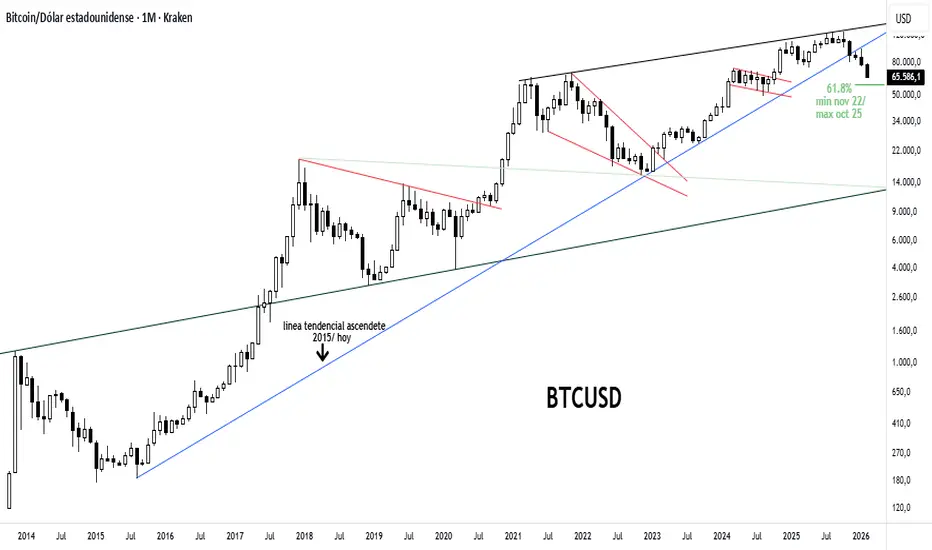
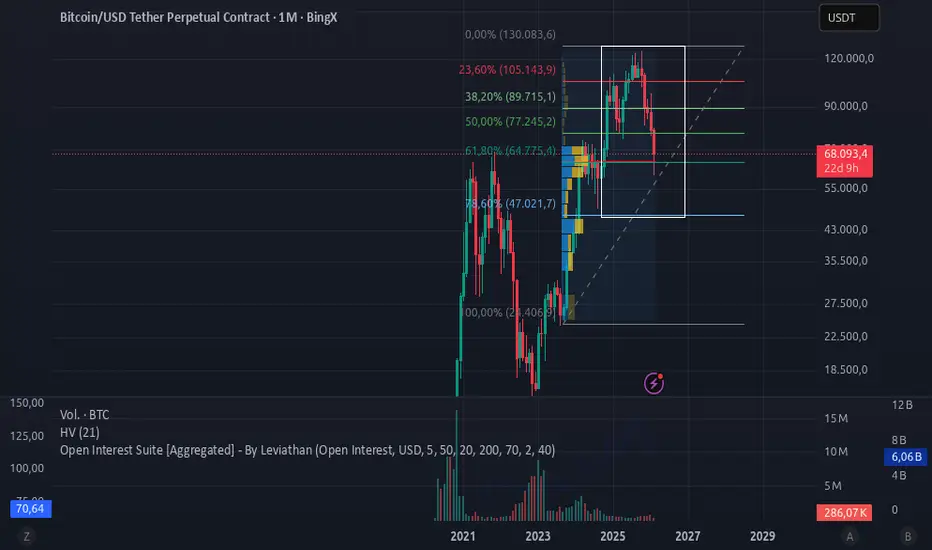
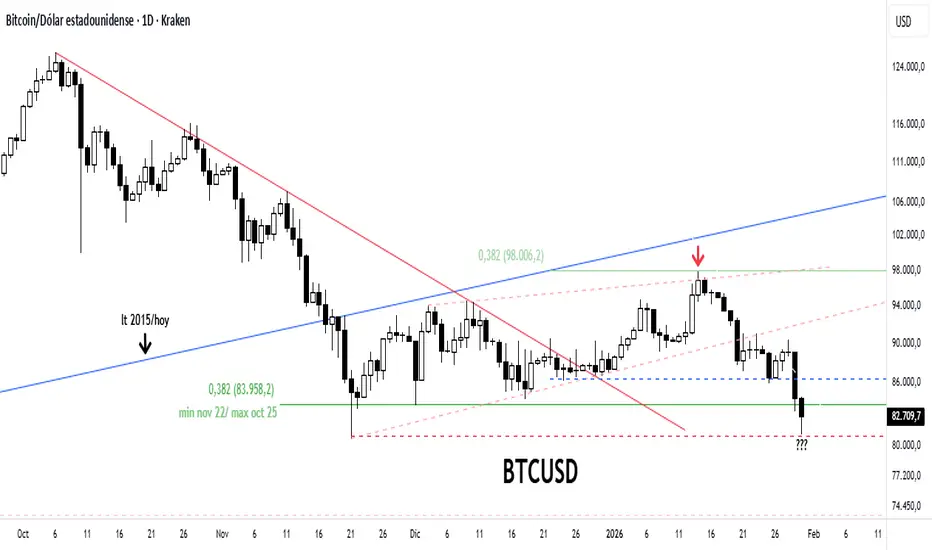
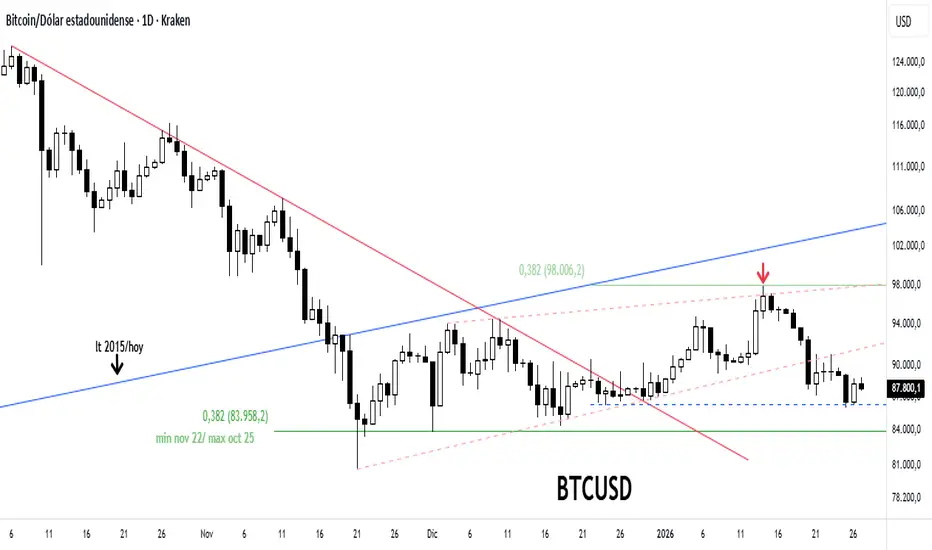
El BTCUSD aun se mantiene sobre soporte extremoEL BTCUSD continua manteniéndose por encima del soporte extremo que fuera apuntada hace casi un mes atrás ( ver informes adjuntos ), me refiero al 38.2% de recorte del movimiento ascendente entre el mínimo de Nov/22 y el máximo de Oct/25, mas aun no ha logrado posicionarse por encima de la 1era resistencia en esta instancia la cual esta representada por la linea tendencial declinante originada en máximos. Solo de poder superarla en terminos base cierre semanal ( no antes ), esta criptomoneda estaría en condiciones reales de un nuevo ataque a la linea tendencial ascendente originada 10 años atrás y que fuera finalmente penetrada un mes atrás, que es sin duda su resistencia mas relevante y de fondo en esta instancia.
BTC, rompiendo cuña alcista a la baja, no convenceCerro otra vela semanal en BTC, lo veremos en velas diarias.
La idea planteada de cuña alcista de resolución bajista sigue vigente, el BTC en estos momentos la esta rompiendo a la baja, pero el volumen no es grande (hasta ahora) por lo que esperaremos a que habra wall street y haya negociacion de etf de bitcoin.
Por el lado de indicadores, MACD esta dando cruce medias a la baja, histogramas cada vez menores.
Por el lado de Koncorde, no hay manos grandes operando, la linea roja saliendo de la montaña, es decir, confirmando venta.
Los objetivos bajistas siguen vigentes, primero la zona de entre 70k a 74 k, y luego pensar en el último máximo en torno a los 55k.
BTC, diario, una mirada más de cerca (spoil: sigue bajista)El BTC luego de haber roto el soporte de la línea punteada, se esfuerza por recuperar el mismo, pero de momento no lo logra. No hay evidencias de tendencia de nada, además el precio se acuña.
Toda mi expectativa esta puesta en que siga a la baja a los objetivos planteados, como mínimo, en las ideas anteriores.
Para pensar en recuperar los máximos antes debe, recuperar el soporte perdido, que se ha vuelto resistencia, romper cuña al alza, luego romper TL bajista también en línea punteada.
De resolver la cuña alcista a la baja, los objetivos planteados siguen vigentes, me inclino mas por los 70.800 usd del o,5 de fibo.
Es importante tener en cuenta que el impulso anterior de marzo de 2020 (4.400 usd) a noviembre del 2021 (55.600 usd) luego trajo un retroceso al 0,5 de fibo (15.700 usd) que es desde donde arranca el soporte perdido. Coincidencia? lo dejo planteado en el grafico.
Si te gusta en analisis, dale impulsar. Si te recontra gusta, compartilo con tus amigos.
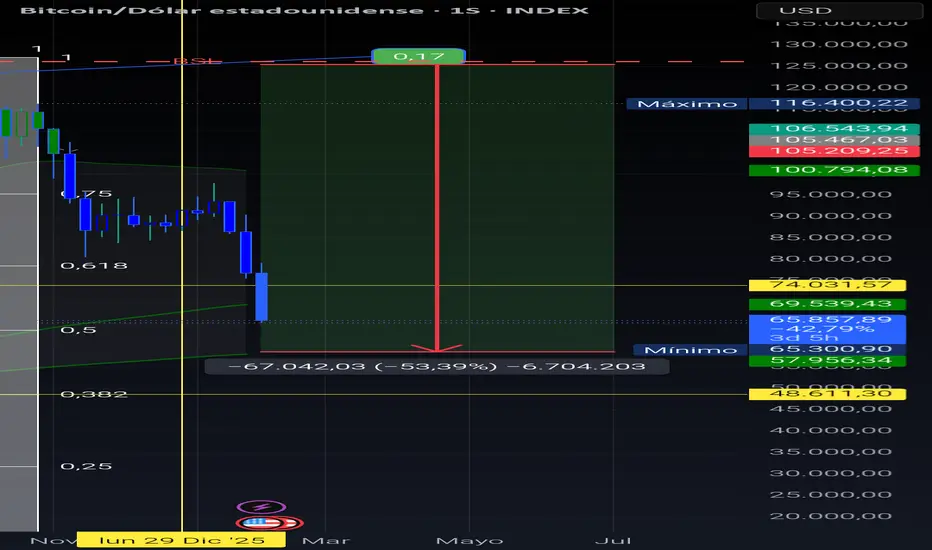
BTCUSDT semanal, sigue bajista Actualizo la idea del BTCUSDT, de momento sigue bajista, ha hecho pie en el 0,618 que seria la zona de 83.900 usd, pero el objetivo de los 73.000 70.000 para mi sigue vigente.
En temporalidad de 1D se observa una cuña bajista, que suele resolver a la baja.
Por otro lado, para pensar en ponernos alcistas, debemos primero vencer la cuña al alza, luego ir contra la TL bajista en trazo punteado rojo.
Otros indicadores como medias moviles muetran que estamos por dejajo de los 8 y 21 d. Aunque el MACD muestra el primer histograma creciente.
Por ahora observo si vuelve a hacer pie en los 83.000 usd, puede ser buen momento para llevar, pensando en llevar mas en los 73.000 - 70.000 usd, mas abajo es muy dificil, no imposible.
BNB: Análisis Histórico & Proyección (DICIEMBRE 2025)🪙 Este análisis mensual de BNB (Binance Coin) combina estructura técnica logarítmica, ciclos de mercado definidos y contexto macroeconómico para proyectar su comportamiento potencial hacia 2026–2027. El gráfico muestra cómo BNB ha seguido un patrón cíclico claro desde su lanzamiento, respetando zonas de soporte clave y consolidaciones antes de cada fase expansiva.
🔍 Factores Clave en la Evolución de BNB
Ciclos de mercado bien estructurados:
Desde 2017, BNB ha atravesado múltiples ciclos de mercado que se alinean con fases de crecimiento del ecosistema Binance y eventos globales. Cada bull market ha venido precedido por una corrección severa (bear market), seguida de una fase de recuperación sobre zonas de soporte logarítmico claramente definidas. El higher low de $183.4 USD en 2022, tras el bear market post-ATH de 2021, sugiere una estructura alcista intacta.
Canal logarítmico de largo plazo:
BNB debido a su comportamiento exponencial se ha mantenido dentro de un canal de crecimiento lineal en escala logarítmica que proyecta objetivos futuros entre $2.300 y $12.000 USD. Esta estructura canalizada ha servido como referencia técnica durante cada fase del ciclo, actuando como zona de acumulación en mínimos y resistencia dinámica en fases de euforia.
Proyección 2026–2027:
Según el modelo cíclico y la estructura logarítmica, BNB podría alcanzar los siguientes niveles en el próximo bull market:
✅ $2.300 USD (3,62x) – Alta probabilidad, zona objetivo conservadora dentro del canal.
⚠️ $5.100 USD (8x) – Probabilidad media, en caso de repetir un rally tipo 2021.
🚨 $12.000 USD (18,8x) – Baja probabilidad, zona eufórica superior del canal, dependiente de factores externos como narrativa de escasez o adopción institucional extrema.
Efecto numerario y pérdida de valor del dólar (M2SL):
El análisis incorpora el crecimiento de la masa monetaria M2 (M2SL) como factor macro. A medida que el dólar pierde poder adquisitivo, activos como BNB —escasos, con utilidad y respaldo de una de las plataformas más grandes del mundo cripto— tienden a apreciarse. No necesariamente porque sean "más valiosos", sino porque el sistema los mide en una moneda que se devalúa estructuralmente. Mientras este modelo económico se mantenga, los activos de este tipo seguirán subiendo de manera exponencial.
Casos de uso e infraestructura Binance:
A diferencia de ciclos anteriores, BNB ya no depende solo de especulación. Es utilizado activamente para pagos de comisiones, participación en lanzamientos (Launchpad), programas DeFi, y más recientemente como activo de colateral. Binance, con presencia global y fuerte peso institucional, respalda su adopción y utilidad. Esto le otorga a BNB un soporte fundamental que refuerza su proyección técnica.
✅ BNB ha demostrado ser uno de los activos más resilientes del ecosistema cripto, con una estructura técnica y fundamental sólida. Si el patrón histórico se mantiene y el contexto macroeconómico continúa empujando capital hacia activos escasos, BNB podría alcanzar un nuevo ATH entre $2.300 y $12.000 USD en el ciclo 2026–2027, con una relación riesgo-recompensa asimétrica especialmente favorable para quienes acumulan durante fases de consolidación.
DOGE: Análisis Histórico & Proyección (DICIEMBRE 2025)🪙 Este análisis mensual de Dogecoin (DOGE) identifica una estructura de ciclos sorprendentemente consistente desde 2014, a pesar de ser una memecoin. El gráfico logarítmico revela patrones repetitivos entre bull y bear markets, así como zonas de soporte clave respetadas a lo largo del tiempo.
🔍 Factores Clave en la Evolución de DOGE
Ciclos coherentes desde 2014:
DOGE ha seguido una dinámica de expansión y corrección muy marcada:
Bear markets prolongados (2014–2015, 2018–2020, 2021–2022).
Higher lows cada ciclo (ej. $0.00009 en 2015 → $0.00134 en 2022).
Bull markets parabólicos en 2017 y 2021 , con rallies extremos impulsados por narrativa viral.
Proyección para el ciclo 2025–2026:
Según la estructura logarítmica, el próximo bull market podría llevar a DOGE a nuevos máximos históricos con tres zonas de objetivo:
✅ Alta probabilidad: $4 USD
⚠️ Media probabilidad: $6 USD
🚨 Baja probabilidad: $10 USD
Efecto numerario e inflación monetaria:
A pesar de ser una memecoin, DOGE no escapa al fenómeno global de inflación monetaria (M2SL). El gráfico incorpora este factor como trasfondo macro. Si el dólar sigue perdiendo poder adquisitivo, incluso activos como DOGE tienden a apreciarse, más aún cuando la narrativa colectiva y la especulación se alinean en ciclos expansivos.
✅ Dogecoin nació como un chiste, pero el mercado lo ha tratado con seriedad cíclica. Su comportamiento técnico ha sido más predecible que muchos otros proyectos "serios". Si el patrón se mantiene y el FOMO regresa en 2025 o 2026, no sería extraño ver a DOGE alcanzar precios entre $4 y $10 USD, impulsado por narrativa, cultura pop y la inercia histórica del mercado cripto.
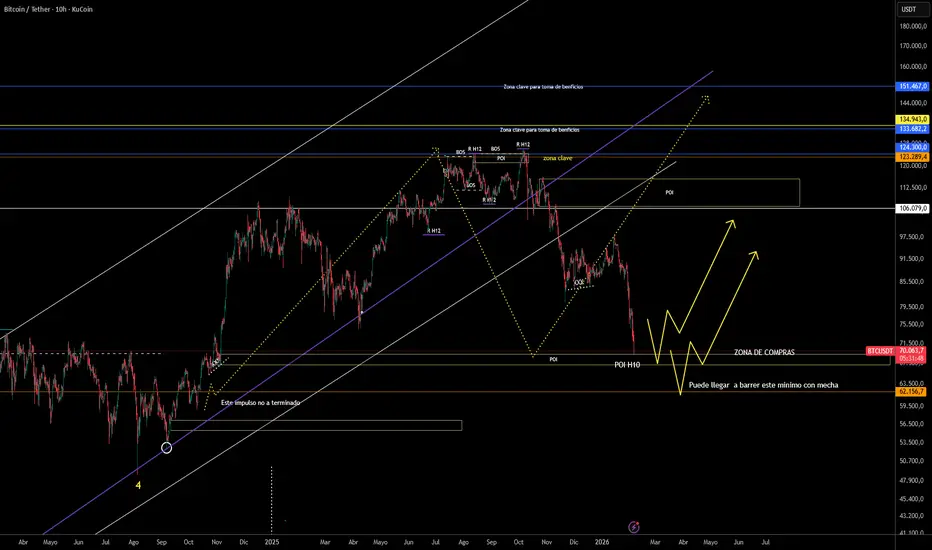
Nuevamente en zona de compras. BTCcuando conoces la estructura del mercado no hay porque paniquearse por una caida por fuerte que sea, y mas cuando la esctructura muestra zonas de liquidez pendientes que el precio podia ir a buscar, los que venden en panico son el combustible para retomar el movimiento alcista.
y aqui dejo mi analisis previo para que no se diga que fue despues de la reaccion
prnt.sc
BTC caera, PERO NO ESTAMOS INICIANDO UN BEART MARKETEn la etiquetas podemos ver los graficos utilizados
Grafico de barras (BTC)
Linea azul (ETH)
Linea punteada celeste (ETH/BTC)
Linea roja (BTC dominancia)
Partiendo de que: "esta vez no debería ser diferente" y que los ciclos no se rompieron
Vemos que los anteriores ciclos habia coincidencia durante la recuperacion de BTC despues de un verdadero beart market, luego el halving de BTC y luego el movimiento parabolico de BTC que tmb desecandebada la altseason (y el retraso de esta misma es la que genera la confusión)
Cuales eran:
ETH y el par de ETH/BTC estaban en una zona de suelo y coincidia con la BTC.D estaba en ATH o en zona de techo. Para cuando estos invierten sus ubicaciones tanto BTC como las altcoins (incluido ETH) estaban en zona de ATH
siempre que BTC empezaba su beart market, el par de ETH/BTC sufria una caida (cosa que no paso en el ultimo beart market)
el inicio del movimiento fuerte lo marcaba el cambio de tendecia de ETH/BTC (cosa que recien esta ocurriendo pero en teoria ya se confirmo)
Variaciones que afectaron este ciclo, pero no significa que lo hayan roto.
un segundo ATH desde el halving 3, donde el par ETH/BTC no cayo como debia ser ( despues esto se corrigio con la caida bestial de ETH)
nuevo ATH antes del halving 4 de BTC, impulsado por la aprobacion del ETF de BTC de BlackRock (esto se podria estar corrigiendo por el movimiento lateral bajista de BTC de este ultimo año)
-El tiempo extendido q estuvimos en QT y que el PMI no subió positivamente como anteriores ciclos
Conclucion: el movimiento de este ciclo se descorrelaciono del resto, como si se hubiese adelantado, pero ya esta tomando la misma forma que tenia en anteriores ciclos y aun tenemos "catalizadores" alcistas como: la terminacion de la guerra Rusia-Ucrania, y el despido de Powell.