
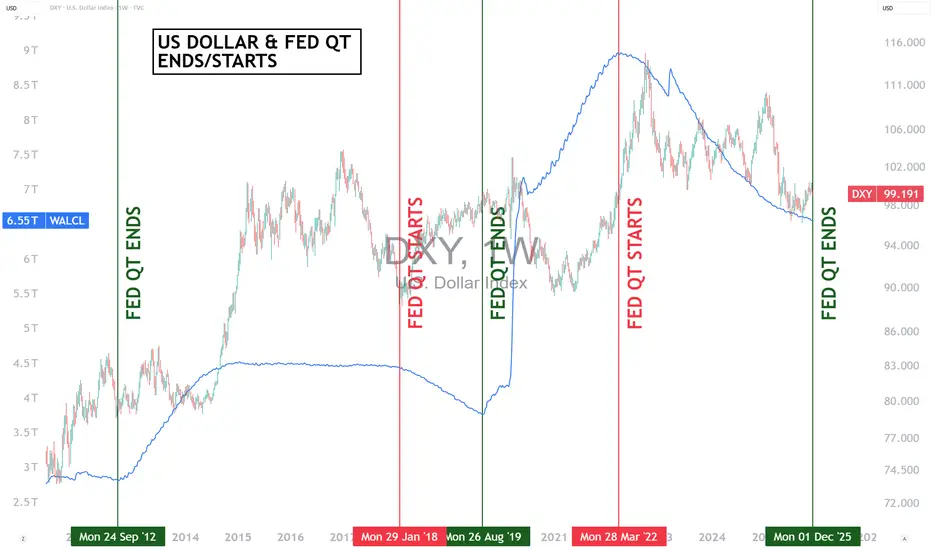
Since Monday, December 1, 2025, the quantitative tightening (QT) program initiated in 2022 has been halted. The evolution of the Federal Reserve’s balance sheet has always had a major impact on financial assets, particularly in the FX market. Through which mechanisms? And what impact should we expect on FX and the US dollar?
Since Monday, December 1, 2025, the US Federal Reserve (Fed) has officially ended the quantitative tightening cycle initiated in 2022. This decision marks an important turning point in US monetary policy: the balance sheet contraction— which had tightened financial conditions for more than three years—has now come to an end. Historically, changes in the Fed’s balance sheet exert a significant influence on financial markets, particularly on the US dollar index (DXY). However, the end of QT does not carry the same meaning as the start of a quantitative easing (QE) program.
Stopping balance sheet reduction means the Fed no longer withdraws liquidity from the financial system. In theory, this is neutral to slightly bearish for the dollar. With less pressure on real interest rates, the relative attractiveness of the dollar diminishes, especially against currencies with higher carry. Historically, in periods when QT ended—such as in 2012 or 2019—the dollar tended to weaken gradually. Simply stabilizing the balance sheet slightly loosens financial conditions, encouraging a rotation toward riskier or higher-yielding assets outside the US.

However, it is essential to emphasize a point that is often misunderstood: the end of QT is absolutely not equivalent to the beginning of QE. In QE, the Fed purchases large quantities of bonds, injecting significant and continuous liquidity into the economy. These purchases put direct downward pressure on long-term yields and weaken the dollar more clearly. Conversely, when QT stops, the Fed essentially does nothing: it no longer withdraws liquidity, but it does not add any either. The balance sheet stabilizes—sometimes with slight fluctuations—but it does not automatically expand again.
The distinction is therefore crucial:
• End of QT = stabilization, moderate impact, often neutral to slightly bearish for the USD.
• Start of QE = balance-sheet expansion, clearly bearish impact as the supply of dollars increases.
In summary, the end of QT in December 2025 may contribute to a slightly less supportive environment for the dollar, but its impact remains limited in the absence of signals pointing to a real shift toward QE. The next few months will therefore depend more on policy rates, inflation trends, and monetary-policy expectations than on the QT halt alone.

DISCLAIMER:
This content is intended for individuals who are familiar with financial markets and instruments and is for information purposes only. The presented idea (including market commentary, market data and observations) is not a work product of any research department of Swissquote or its affiliates. This material is intended to highlight market action and does not constitute investment, legal or tax advice. If you are a retail investor or lack experience in trading complex financial products, it is advisable to seek professional advice from licensed advisor before making any financial decisions.
This content is not intended to manipulate the market or encourage any specific financial behavior.
Swissquote makes no representation or warranty as to the quality, completeness, accuracy, comprehensiveness or non-infringement of such content. The views expressed are those of the consultant and are provided for educational purposes only. Any information provided relating to a product or market should not be construed as recommending an investment strategy or transaction. Past performance is not a guarantee of future results.
Swissquote and its employees and representatives shall in no event be held liable for any damages or losses arising directly or indirectly from decisions made on the basis of this content.
The use of any third-party brands or trademarks is for information only and does not imply endorsement by Swissquote, or that the trademark owner has authorised Swissquote to promote its products or services.
Swissquote is the marketing brand for the activities of Swissquote Bank Ltd (Switzerland) regulated by FINMA, Swissquote Capital Markets Limited regulated by CySEC (Cyprus), Swissquote Bank Europe SA (Luxembourg) regulated by the CSSF, Swissquote Ltd (UK) regulated by the FCA, Swissquote Financial Services (Malta) Ltd regulated by the Malta Financial Services Authority, Swissquote MEA Ltd. (UAE) regulated by the Dubai Financial Services Authority, Swissquote Pte Ltd (Singapore) regulated by the Monetary Authority of Singapore, Swissquote Asia Limited (Hong Kong) licensed by the Hong Kong Securities and Futures Commission (SFC) and Swissquote South Africa (Pty) Ltd supervised by the FSCA.
Products and services of Swissquote are only intended for those permitted to receive them under local law.
All investments carry a degree of risk. The risk of loss in trading or holding financial instruments can be substantial. The value of financial instruments, including but not limited to stocks, bonds, cryptocurrencies, and other assets, can fluctuate both upwards and downwards. There is a significant risk of financial loss when buying, selling, holding, staking, or investing in these instruments. SQBE makes no recommendations regarding any specific investment, transaction, or the use of any particular investment strategy.
CFDs are complex instruments and come with a high risk of losing money rapidly due to leverage. The vast majority of retail client accounts suffer capital losses when trading in CFDs. You should consider whether you understand how CFDs work and whether you can afford to take the high risk of losing your money.
Digital Assets are unregulated in most countries and consumer protection rules may not apply. As highly volatile speculative investments, Digital Assets are not suitable for investors without a high-risk tolerance. Make sure you understand each Digital Asset before you trade.
Cryptocurrencies are not considered legal tender in some jurisdictions and are subject to regulatory uncertainties.
The use of Internet-based systems can involve high risks, including, but not limited to, fraud, cyber-attacks, network and communication failures, as well as identity theft and phishing attacks related to crypto-assets.
Since Monday, December 1, 2025, the US Federal Reserve (Fed) has officially ended the quantitative tightening cycle initiated in 2022. This decision marks an important turning point in US monetary policy: the balance sheet contraction— which had tightened financial conditions for more than three years—has now come to an end. Historically, changes in the Fed’s balance sheet exert a significant influence on financial markets, particularly on the US dollar index (DXY). However, the end of QT does not carry the same meaning as the start of a quantitative easing (QE) program.
Stopping balance sheet reduction means the Fed no longer withdraws liquidity from the financial system. In theory, this is neutral to slightly bearish for the dollar. With less pressure on real interest rates, the relative attractiveness of the dollar diminishes, especially against currencies with higher carry. Historically, in periods when QT ended—such as in 2012 or 2019—the dollar tended to weaken gradually. Simply stabilizing the balance sheet slightly loosens financial conditions, encouraging a rotation toward riskier or higher-yielding assets outside the US.
However, it is essential to emphasize a point that is often misunderstood: the end of QT is absolutely not equivalent to the beginning of QE. In QE, the Fed purchases large quantities of bonds, injecting significant and continuous liquidity into the economy. These purchases put direct downward pressure on long-term yields and weaken the dollar more clearly. Conversely, when QT stops, the Fed essentially does nothing: it no longer withdraws liquidity, but it does not add any either. The balance sheet stabilizes—sometimes with slight fluctuations—but it does not automatically expand again.
The distinction is therefore crucial:
• End of QT = stabilization, moderate impact, often neutral to slightly bearish for the USD.
• Start of QE = balance-sheet expansion, clearly bearish impact as the supply of dollars increases.
In summary, the end of QT in December 2025 may contribute to a slightly less supportive environment for the dollar, but its impact remains limited in the absence of signals pointing to a real shift toward QE. The next few months will therefore depend more on policy rates, inflation trends, and monetary-policy expectations than on the QT halt alone.
DISCLAIMER:
This content is intended for individuals who are familiar with financial markets and instruments and is for information purposes only. The presented idea (including market commentary, market data and observations) is not a work product of any research department of Swissquote or its affiliates. This material is intended to highlight market action and does not constitute investment, legal or tax advice. If you are a retail investor or lack experience in trading complex financial products, it is advisable to seek professional advice from licensed advisor before making any financial decisions.
This content is not intended to manipulate the market or encourage any specific financial behavior.
Swissquote makes no representation or warranty as to the quality, completeness, accuracy, comprehensiveness or non-infringement of such content. The views expressed are those of the consultant and are provided for educational purposes only. Any information provided relating to a product or market should not be construed as recommending an investment strategy or transaction. Past performance is not a guarantee of future results.
Swissquote and its employees and representatives shall in no event be held liable for any damages or losses arising directly or indirectly from decisions made on the basis of this content.
The use of any third-party brands or trademarks is for information only and does not imply endorsement by Swissquote, or that the trademark owner has authorised Swissquote to promote its products or services.
Swissquote is the marketing brand for the activities of Swissquote Bank Ltd (Switzerland) regulated by FINMA, Swissquote Capital Markets Limited regulated by CySEC (Cyprus), Swissquote Bank Europe SA (Luxembourg) regulated by the CSSF, Swissquote Ltd (UK) regulated by the FCA, Swissquote Financial Services (Malta) Ltd regulated by the Malta Financial Services Authority, Swissquote MEA Ltd. (UAE) regulated by the Dubai Financial Services Authority, Swissquote Pte Ltd (Singapore) regulated by the Monetary Authority of Singapore, Swissquote Asia Limited (Hong Kong) licensed by the Hong Kong Securities and Futures Commission (SFC) and Swissquote South Africa (Pty) Ltd supervised by the FSCA.
Products and services of Swissquote are only intended for those permitted to receive them under local law.
All investments carry a degree of risk. The risk of loss in trading or holding financial instruments can be substantial. The value of financial instruments, including but not limited to stocks, bonds, cryptocurrencies, and other assets, can fluctuate both upwards and downwards. There is a significant risk of financial loss when buying, selling, holding, staking, or investing in these instruments. SQBE makes no recommendations regarding any specific investment, transaction, or the use of any particular investment strategy.
CFDs are complex instruments and come with a high risk of losing money rapidly due to leverage. The vast majority of retail client accounts suffer capital losses when trading in CFDs. You should consider whether you understand how CFDs work and whether you can afford to take the high risk of losing your money.
Digital Assets are unregulated in most countries and consumer protection rules may not apply. As highly volatile speculative investments, Digital Assets are not suitable for investors without a high-risk tolerance. Make sure you understand each Digital Asset before you trade.
Cryptocurrencies are not considered legal tender in some jurisdictions and are subject to regulatory uncertainties.
The use of Internet-based systems can involve high risks, including, but not limited to, fraud, cyber-attacks, network and communication failures, as well as identity theft and phishing attacks related to crypto-assets.

This content is written by Vincent Ganne for Swissquote.
This content is intended for individuals who are familiar with financial markets and instruments and is for information purposes only and does not constitute investment, legal or tax advice.
This content is intended for individuals who are familiar with financial markets and instruments and is for information purposes only and does not constitute investment, legal or tax advice.
Exención de responsabilidad
La información y las publicaciones no constituyen, ni deben considerarse como asesoramiento o recomendaciones financieras, de inversión, de trading o de otro tipo proporcionadas o respaldadas por TradingView. Más información en Condiciones de uso.
This content is written by Vincent Ganne for Swissquote.
This content is intended for individuals who are familiar with financial markets and instruments and is for information purposes only and does not constitute investment, legal or tax advice.
This content is intended for individuals who are familiar with financial markets and instruments and is for information purposes only and does not constitute investment, legal or tax advice.
Exención de responsabilidad
La información y las publicaciones no constituyen, ni deben considerarse como asesoramiento o recomendaciones financieras, de inversión, de trading o de otro tipo proporcionadas o respaldadas por TradingView. Más información en Condiciones de uso.