
The S&P 500 is following a long-term bullish trend, and corrections never last more than a few trading sessions, or at worst a few weeks. Can this underlying bullish momentum continue for several more months, or even throughout the entire year of 2027?
To answer this question, the most common approach is to use a combination of fundamental and technical factors. For example, I often show in my market analyses on TradingView that the underlying bullish trend is likely to resume as long as the US stock market does not reach an excessive valuation level.
But there is another approach that should not be underestimated: the cyclical approach. Several cycles can influence the trend of the S&P 500 Index, but the so-called “presidential cycle” is by far the most powerful and statistically documented.
Permabulls and permabears have strong opinions about the market, but these opinions are often ideological. Statistics, on the other hand, do not lie and are factual.
Let us now explain what the US presidential cycle is and why the third year of the presidential cycle — which will be 2027 — has historically been the strongest of all four years.
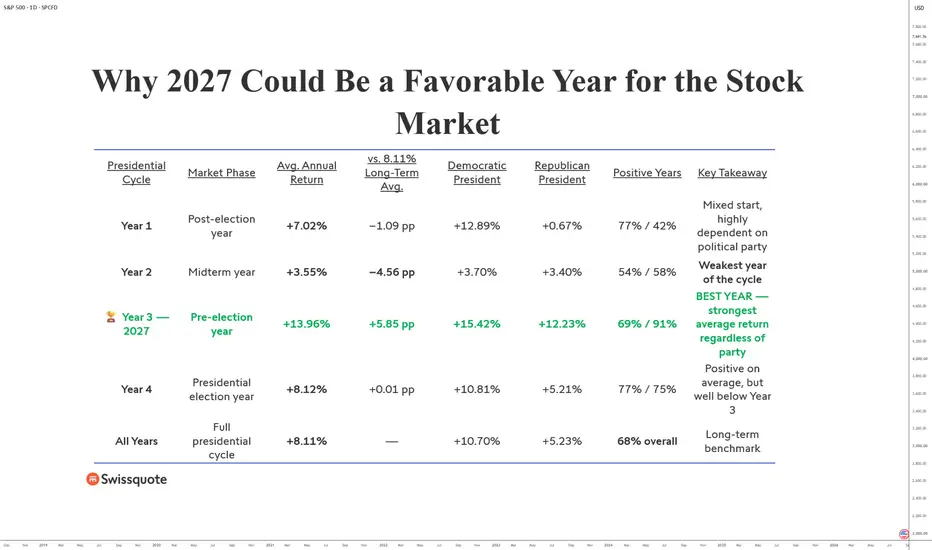
The presidential cycle is based on a simple observation: the performance of the US stock market is not distributed evenly across the four years of a presidential term. Since 1928, historical S&P 500 data show that the third year of the presidential term has recorded the strongest average performance. Conversely, the second year has historically been the most difficult, while the first and fourth years have produced intermediate performances.
The table below presents the presidential cycle statistics and highlights the bullish strength of the third year — namely, the upcoming year 2027. (Source: gurufocus.com).

Why does this phenomenon occur? The most commonly cited explanation is that US administrations generally seek to support economic activity ahead of presidential elections. Fiscal measures, stimulus programs, public spending and a political environment that is more favorable to financial markets tend to produce their effects during the third year of the presidential term. Of course, this cycle is not an immutable law and can be disrupted by exceptional events such as a financial crisis, a pandemic or a major geopolitical shock. Nevertheless, over nearly a century of data, this seasonality has proven remarkably robust.
The figures are particularly compelling. Since 1928, the third year of the presidential cycle has generated an average annual performance close to 14%, well above the historical average annual return of the S&P 500, which stands at around 8%. Even more interestingly, this statistical outperformance is found under both Democratic and Republican presidencies. In other words, the political factor appears to be less important than the position within the presidential cycle itself.
History never repeats itself exactly, but it often rhymes. The presidential cycle obviously does not guarantee that markets will rise in 2027, but it provides an additional statistical argument in favor of a medium-term bullish scenario.
DISCLAIMER:
This content is intended for individuals who are familiar with financial markets and instruments and is for information purposes only. The presented idea (including market commentary, market data and observations) is not a work product of any research department of Swissquote or its affiliates. This material is intended to highlight market action and does not constitute investment, legal or tax advice. If you are a retail investor or lack experience in trading complex financial products, it is advisable to seek professional advice from licensed advisor before making any financial decisions.
This content is not intended to manipulate the market or encourage any specific financial behavior.
Swissquote makes no representation or warranty as to the quality, completeness, accuracy, comprehensiveness or non-infringement of such content. The views expressed are those of the consultant and are provided for educational purposes only. Any information provided relating to a product or market should not be construed as recommending an investment strategy or transaction. Past performance is not a guarantee of future results.
Swissquote and its employees and representatives shall in no event be held liable for any damages or losses arising directly or indirectly from decisions made on the basis of this content.
The use of any third-party brands or trademarks is for information only and does not imply endorsement by Swissquote, or that the trademark owner has authorised Swissquote to promote its products or services.
Swissquote is the marketing brand for the activities of Swissquote Bank Ltd (Switzerland) regulated by FINMA, Swissquote Capital Markets Limited regulated by CySEC (Cyprus), Swissquote Bank Europe SA (Luxembourg) regulated by the CSSF, Swissquote Ltd (UK) regulated by the FCA, Swissquote Financial Services (Malta) Ltd regulated by the Malta Financial Services Authority, Swissquote MEA Ltd. (UAE) regulated by the Dubai Financial Services Authority, Swissquote Pte Ltd (Singapore) regulated by the Monetary Authority of Singapore, Swissquote Asia Limited (Hong Kong) licensed by the Hong Kong Securities and Futures Commission (SFC) and Swissquote South Africa (Pty) Ltd supervised by the FSCA.
Products and services of Swissquote are only intended for those permitted to receive them under local law.
All investments carry a degree of risk. The risk of loss in trading or holding financial instruments can be substantial. The value of financial instruments, including but not limited to stocks, bonds, cryptocurrencies, and other assets, can fluctuate both upwards and downwards. There is a significant risk of financial loss when buying, selling, holding, staking, or investing in these instruments. SQBE makes no recommendations regarding any specific investment, transaction, or the use of any particular investment strategy.
CFDs are complex instruments and come with a high risk of losing money rapidly due to leverage. The vast majority of retail client accounts suffer capital losses when trading in CFDs. You should consider whether you understand how CFDs work and whether you can afford to take the high risk of losing your money.
Digital Assets are unregulated in most countries and consumer protection rules may not apply. As highly volatile speculative investments, Digital Assets are not suitable for investors without a high-risk tolerance. Make sure you understand each Digital Asset before you trade.
Cryptocurrencies are not considered legal tender in some jurisdictions and are subject to regulatory uncertainties.
The use of Internet-based systems can involve high risks, including, but not limited to, fraud, cyber-attacks, network and communication failures, as well as identity theft and phishing attacks related to crypto-assets.
To answer this question, the most common approach is to use a combination of fundamental and technical factors. For example, I often show in my market analyses on TradingView that the underlying bullish trend is likely to resume as long as the US stock market does not reach an excessive valuation level.
But there is another approach that should not be underestimated: the cyclical approach. Several cycles can influence the trend of the S&P 500 Index, but the so-called “presidential cycle” is by far the most powerful and statistically documented.
Permabulls and permabears have strong opinions about the market, but these opinions are often ideological. Statistics, on the other hand, do not lie and are factual.
Let us now explain what the US presidential cycle is and why the third year of the presidential cycle — which will be 2027 — has historically been the strongest of all four years.
The presidential cycle is based on a simple observation: the performance of the US stock market is not distributed evenly across the four years of a presidential term. Since 1928, historical S&P 500 data show that the third year of the presidential term has recorded the strongest average performance. Conversely, the second year has historically been the most difficult, while the first and fourth years have produced intermediate performances.
The table below presents the presidential cycle statistics and highlights the bullish strength of the third year — namely, the upcoming year 2027. (Source: gurufocus.com).
Why does this phenomenon occur? The most commonly cited explanation is that US administrations generally seek to support economic activity ahead of presidential elections. Fiscal measures, stimulus programs, public spending and a political environment that is more favorable to financial markets tend to produce their effects during the third year of the presidential term. Of course, this cycle is not an immutable law and can be disrupted by exceptional events such as a financial crisis, a pandemic or a major geopolitical shock. Nevertheless, over nearly a century of data, this seasonality has proven remarkably robust.
The figures are particularly compelling. Since 1928, the third year of the presidential cycle has generated an average annual performance close to 14%, well above the historical average annual return of the S&P 500, which stands at around 8%. Even more interestingly, this statistical outperformance is found under both Democratic and Republican presidencies. In other words, the political factor appears to be less important than the position within the presidential cycle itself.
History never repeats itself exactly, but it often rhymes. The presidential cycle obviously does not guarantee that markets will rise in 2027, but it provides an additional statistical argument in favor of a medium-term bullish scenario.
DISCLAIMER:
This content is intended for individuals who are familiar with financial markets and instruments and is for information purposes only. The presented idea (including market commentary, market data and observations) is not a work product of any research department of Swissquote or its affiliates. This material is intended to highlight market action and does not constitute investment, legal or tax advice. If you are a retail investor or lack experience in trading complex financial products, it is advisable to seek professional advice from licensed advisor before making any financial decisions.
This content is not intended to manipulate the market or encourage any specific financial behavior.
Swissquote makes no representation or warranty as to the quality, completeness, accuracy, comprehensiveness or non-infringement of such content. The views expressed are those of the consultant and are provided for educational purposes only. Any information provided relating to a product or market should not be construed as recommending an investment strategy or transaction. Past performance is not a guarantee of future results.
Swissquote and its employees and representatives shall in no event be held liable for any damages or losses arising directly or indirectly from decisions made on the basis of this content.
The use of any third-party brands or trademarks is for information only and does not imply endorsement by Swissquote, or that the trademark owner has authorised Swissquote to promote its products or services.
Swissquote is the marketing brand for the activities of Swissquote Bank Ltd (Switzerland) regulated by FINMA, Swissquote Capital Markets Limited regulated by CySEC (Cyprus), Swissquote Bank Europe SA (Luxembourg) regulated by the CSSF, Swissquote Ltd (UK) regulated by the FCA, Swissquote Financial Services (Malta) Ltd regulated by the Malta Financial Services Authority, Swissquote MEA Ltd. (UAE) regulated by the Dubai Financial Services Authority, Swissquote Pte Ltd (Singapore) regulated by the Monetary Authority of Singapore, Swissquote Asia Limited (Hong Kong) licensed by the Hong Kong Securities and Futures Commission (SFC) and Swissquote South Africa (Pty) Ltd supervised by the FSCA.
Products and services of Swissquote are only intended for those permitted to receive them under local law.
All investments carry a degree of risk. The risk of loss in trading or holding financial instruments can be substantial. The value of financial instruments, including but not limited to stocks, bonds, cryptocurrencies, and other assets, can fluctuate both upwards and downwards. There is a significant risk of financial loss when buying, selling, holding, staking, or investing in these instruments. SQBE makes no recommendations regarding any specific investment, transaction, or the use of any particular investment strategy.
CFDs are complex instruments and come with a high risk of losing money rapidly due to leverage. The vast majority of retail client accounts suffer capital losses when trading in CFDs. You should consider whether you understand how CFDs work and whether you can afford to take the high risk of losing your money.
Digital Assets are unregulated in most countries and consumer protection rules may not apply. As highly volatile speculative investments, Digital Assets are not suitable for investors without a high-risk tolerance. Make sure you understand each Digital Asset before you trade.
Cryptocurrencies are not considered legal tender in some jurisdictions and are subject to regulatory uncertainties.
The use of Internet-based systems can involve high risks, including, but not limited to, fraud, cyber-attacks, network and communication failures, as well as identity theft and phishing attacks related to crypto-assets.

This content is written by Vincent Ganne for Swissquote.
This content is intended for individuals who are familiar with financial markets and instruments and is for information purposes only and does not constitute investment, legal or tax advice.
This content is intended for individuals who are familiar with financial markets and instruments and is for information purposes only and does not constitute investment, legal or tax advice.
Exención de responsabilidad
La información y las publicaciones no constituyen, ni deben considerarse como, asesoramiento o recomendaciones financieras, de inversión, de trading u otro tipo, proporcionadas o respaldadas por TradingView. Obtenga más información en Condiciones de uso.